
The sales methodologies that dominated the 1990s and 2000s: SPIN Selling, Challenger, Miller Heiman, MEDDIC, aren’t wrong.
They’re just incomplete for today’s B2B buying environment.

Modern buyers are more informed, buying committees are larger, and the path to purchase is no longer linear.
Yet many companies struggle to find a sales methodology that fits their reality.
Enterprise frameworks feel too complex and expensive. Generic training programmes provide inspiration but little structure.
Meanwhile, their sales teams improvise, leading to inconsistent results and unpredictable revenue.
What if there was a better way?
A structured approach that combines the best of proven methodologies while addressing modern buyer behaviour, without requiring enterprise-level resources to implement?
Why Traditional Sales Methodologies Fall Short Today
Before we explore the solution, let’s understand what’s changed in B2B sales:
- Buyer independence: Buyers complete 57% of the purchase decision before ever engaging with sales, according to CEB research. They’re not waiting for you to educate them—they’re educating themselves.
- Committee complexity: The average B2B purchase now involves 6-10 stakeholders, each with their own priorities and concerns. Selling to one person isn’t enough.
- Value demand: Buyers aren’t impressed by features anymore. They expect salespeople to quantify business impact and justify investment with clear ROI.
- Process dysfunction: Most sales teams lack a consistent, repeatable process. Each rep sells their own way, making it impossible to scale success or coach effectively.
Traditional methodologies address some of these challenges but rarely all of them.
SPIN Selling focuses on questioning but doesn’t address qualification.
MEDDIC handles qualification brilliantly but lacks a discovery framework.
Challenger excels at insight delivery but assumes you’ve already qualified the opportunity.
Introducing the Five-Stage Modern Sales Framework
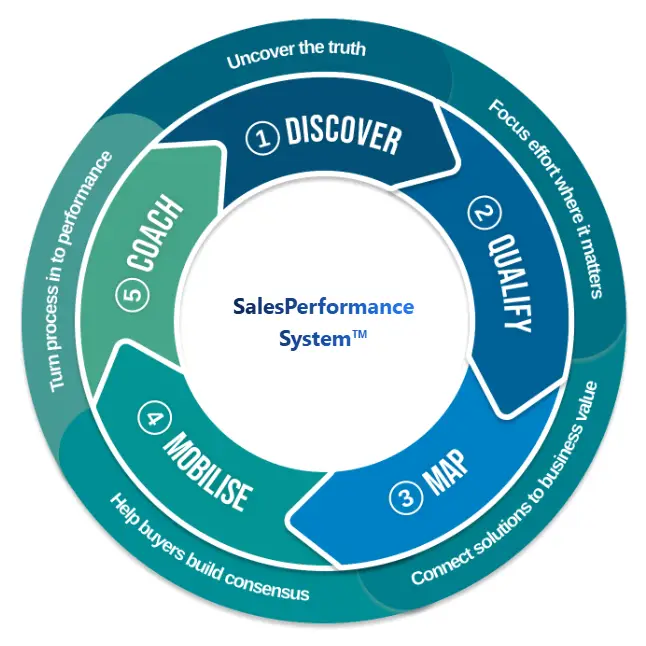
The most effective B2B sales process isn’t a single methodology—it’s a synthesis of proven approaches, adapted for modern buyers and structured for execution.
Here are the five essential stages every sales team needs:
Stage 1: Discover the Truth™
Purpose: Move beyond surface-level needs to uncover business impact and establish credibility.
Most sales conversations start with “What are you looking for?”
This invites feature-focused discussions that commoditise your solution.
Instead, structured discovery helps you understand:
- The current situation and its implications
- The problems created by maintaining the status quo
- The financial and operational impact of these problems
- The value of solving these problems successfully
The modern twist: Today’s buyers expect insight, not interrogation. Your discovery questions should teach as much as they learn, positioning you as a strategic adviser rather than a vendor.
Example: Instead of asking “Do you have a CRM?” ask “How does your team currently track pipeline visibility, and what decisions are you unable to make because of gaps in that visibility?”
This discovery question reveals their current state, implies a problem, and positions you as someone who understands their world.
Stage 2: Qualify for Growth™
Purpose: Focus resources on opportunities you can actually win.
Not every opportunity deserves equal attention. Poor qualification is the silent killer of sales productivity.
Your team wastes time on deals that were never going to close while neglecting opportunities with real potential.
Effective qualification answers five critical questions:
- Compelling Event: Is there a reason this needs to be solved now? Without urgency, deals drag or die.
- Decision Process: Who makes decisions, and what’s their evaluation process? Understanding the path to purchase prevents surprises.
- Budget: Not just “Is there budget?” but “What trade-offs will be required to fund this investment?”
- Authority: Who can say yes, and who can say no? In complex sales, there are multiple stakeholders with veto power.
- Champion: Do you have someone inside the organisation who will advocate for your solution when you’re not in the room?
The modern twist: Qualification isn’t a checkbox exercise. It’s an ongoing assessment.
As you learn more about the opportunity, your qualification should evolve. The best salespeople constantly ask “Should we still be pursuing this?”
The discipline: Be willing to exit deals that don’t qualify.
This feels counterintuitive, but it’s liberating—it frees your team to focus on opportunities they can actually win.
Stage 3: Map the Value™
Purpose: Link your solution to measurable business outcomes that justify the investment.
Here’s where most sales teams fail: they explain what their product does instead of what it achieves.
Buyers don’t care about features—they care about outcomes. Your job is to build a clear business case that quantifies the value of solving their problem.
Effective value mapping includes:
- Current state cost: What’s the cost of maintaining the status quo? This includes direct costs (money spent), indirect costs (inefficiency), and opportunity costs (revenue not captured).
- Future state value: What measurable improvements will your solution enable? Be specific—”improve productivity” is vague, but “reduce month-end close from 10 days to 3 days” is concrete.
- ROI calculation: Show the financial return on their investment. Include implementation costs, ongoing costs, and time to value.
- Risk mitigation: Address what happens if they do nothing. The cost of inaction is often more compelling than the benefit of action.
The modern twist: Build the business case with the customer, not for them.
When buyers contribute to the ROI calculation, they own it psychologically. It becomes their business case, not yours.
The discipline: If you can’t articulate clear, measurable value, you don’t have a qualified opportunity. Return to discovery before advancing the deal.
Stage 4: Mobilise the Team™
Purpose: Navigate complex buying committees and build consensus across stakeholders.
B2B sales are won and lost in internal meetings you’re not invited to.
Your champion may love your solution, but they need to convince finance, IT, operations, and the C-suite.
If you haven’t equipped them to sell on your behalf, the deal will stall.
Effective stakeholder mobilisation requires:
- Stakeholder mapping: Identify all decision-makers and influencers early. Understand what each person cares about and what concerns they’re likely to raise.
- Champion enablement: Give your champion the materials, talking points, and answers they need to advocate effectively. This might include executive summaries, ROI one-pagers, or FAQ documents that address common objections.
- Consensus building: Create opportunities to address stakeholders directly when possible. Multi-threaded relationships—where you have direct contact with multiple stakeholders—dramatically increase win rates.
- Objection anticipation: Work with your champion to identify likely objections and prepare responses before internal meetings happen.
The modern twist: In today’s remote-first world, most stakeholder conversations happen asynchronously through email and Slack.
Your materials need to work without you there to present them. Think “self-service selling.”
The discipline: If you only have one contact inside an organisation, you don’t have a deal; you have a relationship.
Push to expand your stakeholder map, even when your champion resists.
Stage 5: Commit & Coach™
Purpose: Close with confidence and embed winning behaviours through systematic coaching.
This final stage has two components: closing the current deal and developing skills for future deals.
Closing the Deal:
- Create mutual action plans that outline next steps for both parties
- Handle objections by revisiting the value case and addressing specific concerns
- Ask for commitment directly—most deals are lost because salespeople never actually ask for the business
- Negotiate from value, not price—if you’ve done Stages 1-4 well, price becomes a non-issue
Systematic Coaching:
The real power of a structured methodology emerges when managers coach to it consistently.
Instead of generic feedback, managers can assess performance against each stage:
- “Your discovery was strong, but I noticed you didn’t uncover the financial impact. Let’s roleplay how you might have asked that differently.”
- “This opportunity isn’t properly qualified—we don’t know the decision process. What questions do you need to ask in your next call?”
- “Your value story focuses on features. Let’s rewrite it to emphasise business outcomes instead.”
The modern twist: Use deal reviews as teaching moments. When managers analyse wins and losses through the lens of the five stages, patterns emerge that inform team-wide coaching priorities.
The discipline: Dedicate at least 50% of manager-rep one-on-one time to skill development, not just pipeline review. Numbers are an outcome—coaching drives the behaviours that create those numbers.
Why This Approach Works for Growing Teams
Unlike enterprise-focused methodologies that require months of implementation and massive change management, this five-stage framework is designed for practical execution:
- Practical, not theoretical: Each stage includes specific actions reps can implement immediately.
- Scalable, not rigid: The framework adapts to different sale complexities and buying journeys.
- Coachable, not abstract: Managers can assess performance against clear criteria and provide specific feedback.
- Integrated, not piecemeal: All five stages work together as a system, not standalone tactics.
Most importantly, it addresses the complete sales cycle from first conversation to closed deal rather than optimising isolated parts of the process.
Assess Your Team’s Current Performance
Understanding a framework is one thing. Knowing where your team currently stands is another.
That’s why we created the SalesPerformance Snapshot™—a diagnostic that assesses your team’s effectiveness across all five stages. In just 7 minutes, you’ll discover:
- Which stages your team executes well
- Where gaps are costing you revenue
- Specific recommendations to improve performance
- A roadmap for implementing the five-stage framework
From Framework to Practice
The difference between successful and struggling sales teams isn’t talent or territory—it’s process.
When you give your team a clear, structured methodology that addresses modern buyer behaviour, performance becomes predictable instead of random.
The five stages—Discover, Qualify, Map Value, Mobilise, and Coach—provide that structure. They connect proven sales principles into a complete system designed for today’s complex B2B environment.
The question isn’t whether this approach works. It’s whether you’ll implement it before your competitors do.
About SalesPerformance Group
SalesPerformance Group brings enterprise-grade sales methodologies to growth firms and corporate divisions.
Our SalesPerformance System™ integrates proven sales frameworks into a modern, actionable methodology that embeds into daily workflows and drives measurable results.